Agriculture is an Art, wherein, the soil which can’t be directly consumed is turned into nutritious food by skilled humans with the help of manual or automated tools that make healthy citizens and wealthy nations. Agriculture is the backbone of the Indian Economy and provides food and nutrition security to Indians. In the current scenario, though this is true as a nation, there seems to be an imbalance in state wise agriculture production. Kerala is one of such states where agriculture has gone on backfoot given that all the abiotic factors are ideal for excellent agriculture production opportunities. This research aims to focus on why the state which had agriculture as its main economic activity during the year 1955-56 has presently turned more to the service sector, mainly ecotourism. It also takes a look into the future of Agriculture in Kerala given that things have changed for the tourism industry since COVID. COVID might be an opportunity for the future of Agriculture in Kerala wherein a Keralite has choice to turn back to Agriculture.
The history of agriculture in India is full of shifts from ancient times through invasions and occupations. Ancient India was one of the major industrial markets mainly for textiles and spices. During the 18th century, India was the richest land and expeditions started to discover a sea route to establish a monopoly on spice and other trades. The indigenous people would create the end product manually in a very simple way. When the expedients discovered that producing textile is a simple technique, they soon established their own textile market using modern machines. Sadly, this was the start of colonization of India. The exports were cut down, exploitation increased resulting in slavery and poverty. People were forced to die of starvation. Necessity is the mother of invention. Starvation made people think about growing their own food by ploughing the soil and that’s how subsistence agriculture came into existence. People ploughed the land and produced food for their families. Approximately 77% of the population was involved in agriculture in 1947, the year of independence. Soon it became the main economic activity by the year 1955-56. Interesting fact is that Kerala is the land where Vasco Da Gama first landed and discovered the sea route to India. It was famous among ancient sailors for spices and still is. It has hills known for growing cardamom that are specially called cardamom hills.
Kerala is one of southwestern coastal states of India. Its unique topography with plenty of water sources makes it fertile land, the secret of its greenery. The humid tropical climate makes it ideal for rich agro biodiversity. The forest area of approximately 11,125.59 sq. kms. has a couple of national parks and some wildlife sanctuaries. It is home to varied plant and animal species and has rich ecological diversity. The total area of Kerala is 38,863 square kilometers, 48% of which is occupied by the Sahyadri range, 40% covered by midlands, the rest being covered by Lowlands. The total land area ideal for cultivation is around 34,850 square kilometers with approx. 18,650 sq. kms. good for tea, coffee, rubber and spices. The coastal area of 4000 sq. kms. made up of backwaters, Arabian sea shore and rivers is ideal for paddy, coconut and fishes. The main cultivation is done in the approx. area of 16200 sq. kms. covered by midlands. The crops planted here are cashew, coconut, arecanut, cassava (tapioca), banana, rice, ginger, pepper, sugar-cane and vegetables.
Agrarian Economy of Kerala (Past)
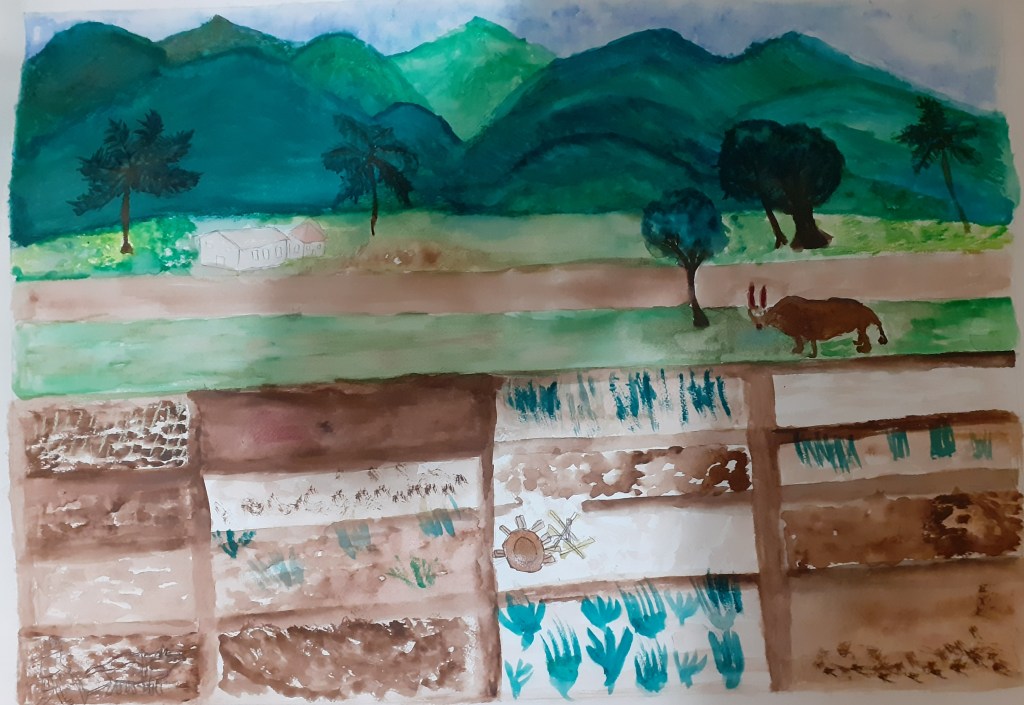
Art Work 1:
This artwork aims to give the idea of how important agriculture was during the past years. It shows the western ghats with coconut and pepper trees. The farmer is ploughing in his paddy field using the animal powered wooden plough. One farmer is using a water wheel in his paddy field known as Chakram. This is the traditional irrigation method used in Kerala. This is made of teak and has planks that rotate circulatory like a cycle wheel. This painting uses watercolors to ensure effective coloring scheme that enhances minute detailing.
During 1955-56, agriculture was the main economic activity of Keralites. Coconut was the main crop that grew almost everywhere, in the lowlands, midland and even on the slope of highland, backwaters, on the river banks, in the house backyards. Paddy cultivation was another main agricultural activity in the wet fields in midland and coastal land. One of the rice varieties grown only in Kerala is Pokkali. Along with rice and coconut, it also grows spices like cardamom and pepper, cashew, cassava, rubber, arecanut, banana and some vegetables. Traditional farming tools commonly used were:
- “Manual-operated” tools: Seed/fertilizer drills, Transplanter, Thresher, Winnower, Sprayer, Duster, Hand pump or other irrigation tools
- “Animal-powered” tools: Wooden plough, Steel plough, Cultivator, Disk harrow, Seed/fertilizer drill, Leveller, Animal cart and Animal-operated irrigation system.
- Machines that are generally used: Internal combustion engine, External combustion engine, Electric engine, Electric motors, Computer for farm management, and other electronic equipment. Tractors: Track-laying tractor, Four-wheel tractor, Single-axle tractor, bulldozer, Carryall, Truck, Trailer, boats for transportation purpose.
- Land preparation and planting machines: Power tiller, Plough, Rotary tiller, Rotary harrow, Disk harrow, Grain drill, Broadcast seeder, Seed/fertilizer drill, Cultivator, planters, Levellers, Diggers, Land plane and Transplanter.
- For crop maintenance: Manure spreader, Fertilizers broadcaster, Sprayer, Duster, Water pump and other localized irrigation device.
- Crop harvesting: Mower for grass crops, Hayrake, Haybaler, Forage harvester, Forage blower, Combine harvesters, Corn picker, Digger, Potato harvester, Sugar beet harvester, Reaper-binder.
- Post-harvest machines: Thresher, Grain cleaner, Sorters and graders.
Shift from agriculture to other alternatives (Present)
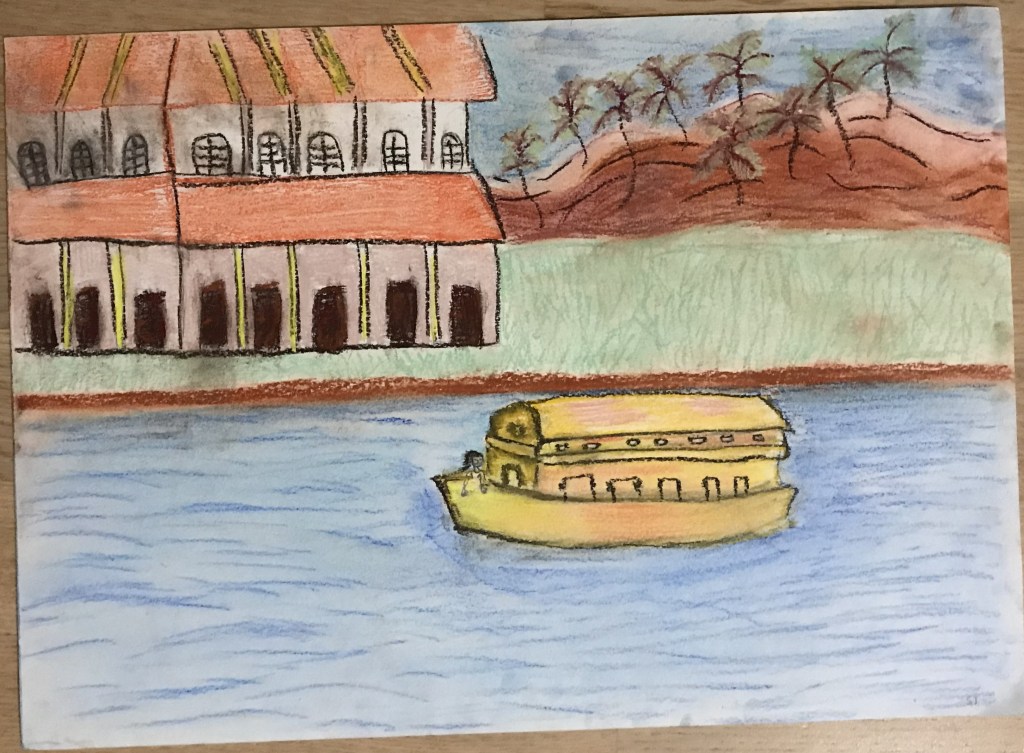
Artwork no. 2 focuses on the present scenario wherein agriculture is on decline in Kerala. The area of agricultural land holdings is lessening as they are being used for non-agricultural purposes. The tourism sector is gaining importance for commercial gains. The artwork shows a resort built near a beach. The resort guests have the privilege to use the beach and houseboat. This artwork aims to address the issue of the exploitation of natural resources for commercial gains. I have used the Oil pastels to create the effect I want my viewers to experience.
Though Kerala is the land with rich biodiversity and ideal conditions for agriculture, in recent times agriculture is facing a setback in Kerala. The service sector is booming in Kerala, being a popular tourist destination. Everyone is inclined towards commercial gains, high income, status jobs. Many times the case is a buyer invests money in agricultural land but does not have any interest in farming. That person changes it to private land, builds a resort and enjoys the luxury of earning high profits. There are laws that ban converting agricultural lands for usage of land for non agricultural purposes but still it is done on a larger scale. The conversion of wet land for other purposes, high cost of labour, shortage of labour has resulted in reduction of the cropping intensity.
Several factors that led to decline in farming in recent years can be summarized as:
- Declining Profitability:
Majority of farmers are marginal farmers and they are unable to earn even the basic returns as productivity is less compared to cost incurred in form of farm price and materials. The declining productivity and low market price has impacted coconut farming. The coconut farming has declined to 38% in 2013-14 as compared to 69% in 1955-56. Same has happened with the paddy cultivation. The area and production of paddy is declining. The investment costs are high and the productivity is less. This has led paddy field workers to turn towards other higher paying alternatives. This shift to the service sector has reduced the number of cultivators and labourers who prefer earning a fixed and higher income than what they earn from agriculture. This cultural transformation and migration has led to decline in agriculture. Decrease in paddy cultivation is mainly alarming as that’s a threat to biodiversity and will automatically affect their resilience and food security.
- Population pressure:
Increasing population has led to decline in operational land holdings. During the last 60 years (between the census held in 1951 and 2011), the population growth recorded in Kerala is 146.6%. In 1955-56, 66.7 % of the total number of holdings in Travancore- Cochin area and 28.9 % in Malabar area were less than one acre in extent. At present, more than 96 % of state land holdings are less than one hectare. The infrastructure design is changing to urbanisation. The land usage for non-agricultural purposes have been increasing on a year to year basis due to increasing population density. Percentage of land used for cultivation has decreased to a large extent as this land is used for building roads, residential & commercial buildings and other constructions. The average size of operational holdings in Kerala is 0.22 hectares. In the period of 20 years, the land holding area has decreased by about 40.5%. The rate of decrease in the first decade is 35 percent and in the last decade is 8 percent. The per capita cultivated land in 1955-56 was 33 cents per person in 2013-14.
- Climate change: This is a worldwide issue. Farmers need to rely on the climate. The climatic patterns are constantly changing. This is impacting the agricultural productivity of the state. Nowadays, the weather conditions are changing in monsoons. The weather is dry and hot which is bad for crops (coconut and areca nuts ) as they cannot grow in this type of weather conditions. The uneven distribution in rainfall pattern is resulting in droughts and floods and the crops are getting damaged.
Agriculture the survival option (Future)
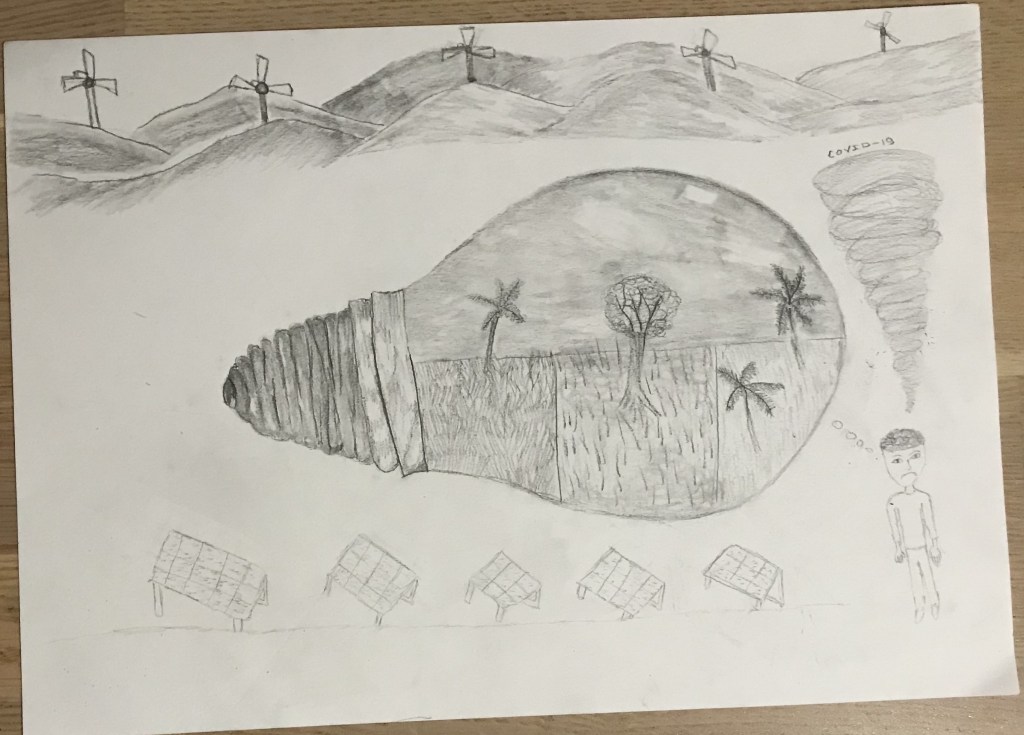
Artwork no. 3: This artwork shows a person who left agriculture in quest to work and earn high incomes in service industry. During COVID 19 the service sector faced setback and he now realizes the value of agriculture. He plans to turn back to agriculture. The artwork aims to show importance of agriculture in future that shall take into account the climate change mitigation techniques. The experimental agroforestry techniques with the plants paddy, Coconut and pepper. The artwork also shows the renewable energy resources. Its goal is to raise awareness and present solutions to two important issues- survival from COVID pandemic losses and Climate Change. The sketch aims to give instant idea of how the future agriculture shall be.
Effects of COVID 19 are not hidden. Service sector, mainly the tourism sector, is the most affected sector during this pandemic. During the last 24 years, the tourism industry recorded significant growth in Kerala. Since January 2020 when the first COVID case was found in Kerala, the number of international and domestic tourists both declined to enormous extent. The revenue losses borne are already very high and would accumulate as the aftereffects of COVID 19 are still seen. No one has any idea as to when things will come back to normal. It feels like history has repeated itself. The discovery of agriculture was done for survival during and after the colonisation era. Today the situation is the same. The option of agriculture is open for future survival. The Local Government shall take the initiative of farming on vacant lands and urge the youths of today to take up farming. The fusion of Traditional and mechanized farming, rooftop farming, community projects, marketing the idea of kitchen gardens are some of the farming ideas for the future. Modern farming techniques would ensure maximum production in minimum area. Paddy cultivation shall be encouraged as it helps maintain ecological balance. Strategy of mitigating climate change can be the introduction of a coconut based agroforestry model with fusion of trees and crops resilient to extreme weather conditions. This model is capable of isolating carbon in the biomass and soil, thus mitigating climate change through reduction in carbon emission. The Government together with the community and other stakeholders will have to make consistent efforts to promote sustainable production practices consistent with the changing climate. Farmers shall be trained to use constant monitoring tools notifying advance alert signals on weather. To mitigate climate change, the renewable energy resources must be used in farming.Pokkali rice farming shall be promoted as it helps mitigate as well as adapt to climate change as it uses traditional techniques and is totally based on organic farming.
 Shra's